





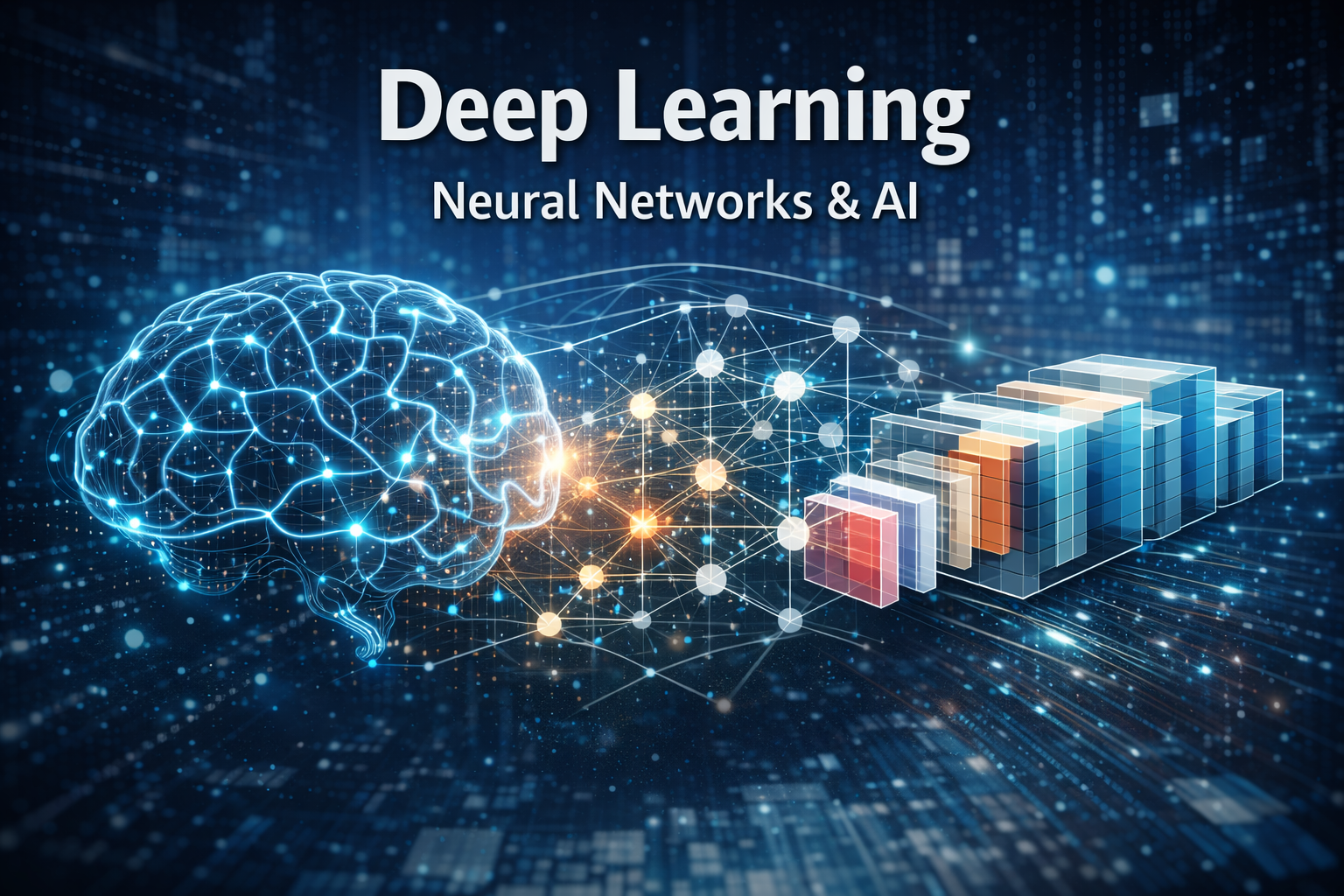
What is Deep Learning?
Deep Learning is one of the most advanced fields of Artificial Intelligence (AI) and a subset of Machine Learning that enables computers to learn from massive amounts of data.
Deep learning uses Artificial Neural Networks, which are inspired by the structure of the human brain. These networks contain multiple layers that allow machines to analyze complex patterns in images, text, audio, and video.
Today, deep learning powers many modern technologies such as voice assistants, recommendation systems, autonomous vehicles, computer vision, and natural language processing.
How Deep Learning Works
Deep learning models use multi-layer neural networks to process data. Each layer extracts different levels of information from the input.
For example, when analyzing an image:
-
The first layers detect edges and shapes
-
Middle layers detect patterns and textures
-
Final layers recognize objects such as faces, animals, or vehicles
Because of this layered structure, deep learning models can understand highly complex data.
Key Applications of Deep Learning
1. Computer Vision
Deep learning is widely used in computer vision for tasks such as:
-
Image recognition
-
Facial recognition
-
Medical image analysis
-
Autonomous driving systems
2. Natural Language Processing (NLP)
In Natural Language Processing, deep learning helps computers understand and generate human language. Examples include:
-
Chatbots
-
Language translation
-
Text summarization
-
AI writing tools
3. Speech Recognition
Voice assistants and speech-to-text systems rely on deep learning to recognize and interpret human speech.
4. Autonomous Vehicles
Self-driving cars use deep learning to detect roads, traffic signs, pedestrians, and other vehicles.
5. Healthcare and Medical Diagnosis
Deep learning models analyze medical scans such as X-rays, CT scans, and MRIs to help doctors detect diseases earlier and more accurately.
6. Recommendation Systems
Platforms like streaming services and online stores use deep learning to recommend movies, products, and content based on user behavior.
Deep Learning vs Machine Learning
Although Deep Learning is part of Machine Learning, there are important differences:
-
Machine learning often requires manual feature engineering
-
Deep learning automatically learns features from data
-
Deep learning usually requires larger datasets and more computing power
-
It performs exceptionally well with images, audio, video, and natural language
Advantages of Deep Learning
Deep learning offers many benefits that make it powerful for AI systems:
-
High accuracy in complex data analysis
-
Ability to learn directly from large datasets
-
Excellent performance in image, speech, and text processing
-
Enables advanced automation and intelligent systems
Challenges of Deep Learning
Despite its advantages, deep learning also has challenges:
-
Requires large datasets
-
Needs powerful hardware such as GPUs
-
Training models can take significant time
-
Models can be complex to interpret and optimize
Why Deep Learning is Important
Deep learning is one of the key technologies driving the future of Artificial Intelligence.
From self-driving cars and smart assistants to medical diagnostics and recommendation systems, deep learning continues to transform industries and improve how machines interact with the world.
As computing power and data availability increase, deep learning will play an even bigger role in shaping the future of technology.
Conclusion
Deep Learning is a powerful technology that allows machines to analyze complex data using multi-layer neural networks. It plays a crucial role in modern AI systems and is widely used in fields such as healthcare, transportation, security, and digital services.
Understanding deep learning is essential for anyone interested in the future of Artificial Intelligence and data-driven technology.